
To do:
Educate young family about why we do not run up to horses.
Check.
Ride Mellie
Check.
Make appt to see pony since Mellie has to leave.
Check. :(
Get great ideas from Grand Master Smith about building a school like curriculum for my business.
Check.
I feel I have been productive!
Loretta the natural horseman clear communication/visible results
Sunday, February 27, 2011
Friday, February 25, 2011
ARIA Certification
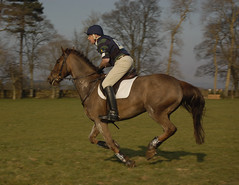 Image by Andrew Pescod via FlickrTaking the test for Certification from the American Riding Instructor Assoc. on April 18!
Loretta
the natural horseman
clear communication/visible results


Thursday, February 24, 2011
Is YOUR horse overweight?
After seeing a friend's comments about overweight dogs I thought I'd broach the same subject. It is shocking to see how many overweight horses there are. Please understand, there are as many health related ailments for overweight horses as there are for humans.
Amplify’d from www.understanding-horse-nutrition.com
Horse Weight:
Why Is It Important?Horse weight is one of the most basic measurements an owner can take, but one that many horse owners don't have.
Knowing your horse's weight helps you do a number of things:
- Monitor health
- Keep track of seasonal weight changes
- Dose medications
- Monitor growth in young horses
- Notice recurring patterns and possible health problems
Many owners (and even veterinarians!) think they are good at guessing a horse weight just by looking at the horse. This is not the case, and even the most "experienced" weight guessers are often off by at least 200 pounds.
In some cases, 200 pounds is not a big deal. However, if you are dosing a very potent medication to a horse that is 500 pounds, and you (or your vet) guess him to be 750 pounds, he is getting an extra half dose of the medication!
This half dose may have no consequences, or it could lead to something as extreme as death. Not to mention, the extra cost to you -- with some medications costing well over $100/dose, I'd rather not give my horse an extra half dose!
As a simple little test of how hard guessing weight can be, take a look at these pictures and see if you can put them in order from heaviest to lightest.
If you guessed that the order from heaviest to lightest is:
- Picture 2 - paint gelding
- Picture 3 - sorrel gelding
- Picture 4 - chestnut mare
- Picture 1 - paint filly
...you would be correct. That was fairly easy though, so now for more of a challenge.
Can you guess their weights??
Here are their weights the day those pictures were taken:
- Picture 2 - paint gelding - 1250 pounds
- Picture 3 - sorrel gelding - 990 pounds
- Picture 4 - chestnut mare - 910 pounds
- Picture 1 - paint filly - 690 pounds
As you can see, guessing a horse's weight is not as easy as most people assume it is. Granted, it is harder to do it from pictures as opposed to in real life, but its the same idea.
Not many people that see these horses in real life realize that the paint gelding is that much heavier than the sorrel gelding.
In fact, most assume that the sorrel is heavier since he is taller and often carries a big belly because of metabolic issues...just one more reason it is SO important to actually measure your horse's weight and not rely on your ability to guess.
Now that you know the importance of actually measuring horse weight, let's look at two ways you can actually accomplish that:
Using a Weight Tape
Using Measurements (and some math!)
Return from Horse Weight to Horse Nutrition Home


See this Amp at http://amplify.com/u/brne6
Wednesday, February 23, 2011
Touched by a horse
| ||||
|




See this Amp at http://amplify.com/u/brg25
Monday, February 21, 2011
Special Needs Equines
 Image via Wikipedia
Hmmmm, sounds like someone I know. Also sounds like some hyper sensitive people. Interesting. It is common to hear talk of people like this. Sometimes they have ADD/ADHD or are Autistic. So why is it that people tend to lump horses into one big category and expect them all to behave the same? (i.e. properly).
Amplify’d from www.performanceequineusa.com
horses is that some horses, no matter how good the training, breeding,
care and equipment, just cannot handle much pressure. These horses are
typically extremely gifted and talented athletes but anxiety and
excitability get in the way of a winning performance.
They are over-sensitive to their surroundings, your show nerves, your tension,
weather, other horses....you name it, they see it, feel it, hear it,
have to look at it and worry about it! These horses require finesse
on the riders part and a great deal of patience and stamina.
These horses often require an absurd amount of warm up time and can be very
complex to show. They run on adrenaline most of the time and fatiguing
them is our only option at a show.
See this Amp at http://amplify.com/u/br48i

Subscribe to:
Comments
(
Atom
)


 Posts
Posts




